ブランド名:
HAINUO
Model Number:
HN46HS
送信
Glass Microbubbles are advanced, lightweight spherical particles with diameters ranging from 10 to 55 micrometers (µm). These tiny hollow spheres are engineered to provide unique physical and chemical properties that make them highly versatile and valuable across numerous industrial applications. With their distinctive white to off-white appearance and spherical shape, Glass Microbubbles offer an exceptional combination of low density and high strength, making them an ideal choice for enhancing material performance while reducing overall weight.
One of the key attributes of Glass Microbubbles is their bulk density, which varies depending on the specific grade selected. This variability allows manufacturers to tailor the microbubbles to meet the precise needs of different applications, whether the priority is minimizing weight, improving insulation, or enhancing mechanical properties. By incorporating these microbubbles, materials can achieve a significant reduction in density without compromising structural integrity, resulting in lighter and more efficient end products.
In addition to their lightweight nature, Glass Microbubbles exhibit excellent chemical resistance. They demonstrate outstanding resilience against a wide range of acids and alkalis, ensuring durability and stability even in harsh chemical environments. This makes them particularly suitable for applications in coatings, composites, adhesives, and sealants where exposure to corrosive substances is common. The chemical resistance also contributes to the longevity of products formulated with Glass Microbubbles, maintaining performance over time.
Thermal management is another critical area where Glass Microbubbles excel. Their hollow structure and low thermal conductivity help to enhance thermal insulation properties in composite materials. By integrating Glass Microbubbles, manufacturers can significantly improve the ability of materials to manage heat flow, reducing heat transfer and improving energy efficiency. This makes them highly beneficial in applications such as automotive parts, electronics, aerospace components, and construction materials where thermal management is crucial.
Beyond insulation, the incorporation of Glass Microbubbles can also enhance thermal conductivity in specific composite formulations designed to dissipate heat effectively. This dual capability allows for versatile engineering solutions tailored to either retain heat or facilitate its transfer, depending on the application requirements. As a result, Glass Microbubbles provide manufacturers with a powerful tool to optimize thermal performance across a broad spectrum of industrial uses.
Furthermore, Glass Microbubbles contribute to achieving a smoother surface finish in coatings and composite materials. Their uniform spherical shape and fine particle size enable a more consistent and even distribution within the host matrix. This leads to improved surface quality, reducing roughness and imperfections in the final product. A smoother surface finish not only enhances aesthetic appeal but also improves functional properties such as reduced friction, better adhesion, and enhanced durability.
The versatility of Glass Microbubbles also extends to their ease of handling and compatibility with various manufacturing processes. Their spherical morphology allows for excellent flow characteristics and dispersion in different mediums, facilitating seamless mixing and integration into resins, polymers, and other base materials. This adaptability makes them suitable for a wide range of industries, including automotive, aerospace, electronics, marine, construction, and consumer goods.
In summary, Glass Microbubbles are a high-performance additive characterized by their diameter range of 10-55 µm, customizable bulk density based on grade, and distinctive white to off-white spherical appearance. Their excellent resistance to acids and alkalis ensures chemical durability, while their unique physical properties enable enhanced thermal management and thermal conductivity. Additionally, Glass Microbubbles contribute to achieving a smoother surface finish, making them an indispensable component for manufacturers aiming to improve product performance, reduce weight, and optimize thermal and surface characteristics.
| Temperature Resistance | Up To 600°C |
| Composition | Silica, Air, And Other Trace Elements |
| Appearance | White To Off-white Spherical Particles |
| True Density | 0.454-0.466 |
| Chemical Resistance | Excellent Resistance To Acids And Alkalis |
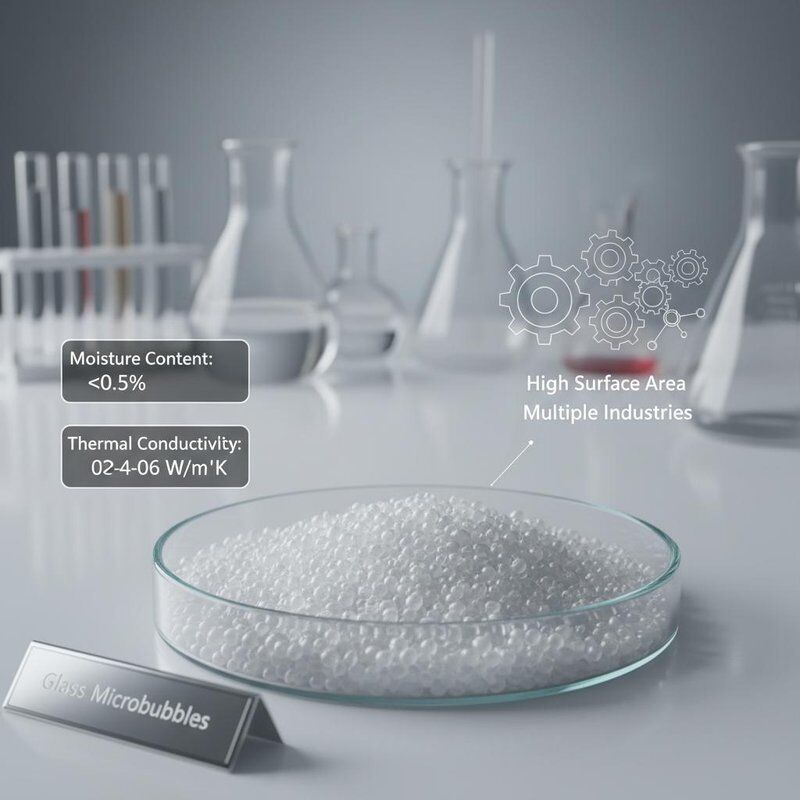
| Moisture Content | <0.5% |
| Thermal Conductivity | 0.153 |
| Bulk Density | Varies Depending On Grade |
| Compressive Strength | 16000 Psi |
| Surface Area | High |
The HAINUO Glass Microbubbles, model number HN46HS, are advanced materials designed to enhance thermal management across a broad range of applications. With a thermal conductivity ranging between 0.04 to 0.06 W/m·K and a thermal condictivity value of 0.153, these microbubbles provide excellent insulation properties that significantly improve the efficiency of thermal management systems. Their unique structure and composition allow them to withstand temperature resistance up to 600°C, making them ideal for use in demanding environments.
In the rubber industry, HAINUO Glass Microbubbles HN46HS are utilized to enhance thermal management in rubber compounds and products. Their inclusion helps in reducing heat buildup and improving the overall thermal stability of rubber materials, which is critical for applications that involve continuous exposure to high temperatures or friction. This results in longer-lasting and more reliable rubber products, especially in automotive and industrial sectors.
For ocean applications, these glass microbubbles are highly valuable in enhancing thermal management in marine coatings, composites, and insulation materials. Their excellent thermal resistance and lightweight nature contribute to better temperature control and improved durability of ocean-going vessels and offshore structures. This ensures that equipment exposed to harsh marine environments can maintain optimal performance and longevity.
In the automobile industry, HAINUO Glass Microbubbles HN46HS play a crucial role in enhancing thermal management within vehicle components. Their ability to withstand high temperatures and provide effective insulation helps in reducing heat transfer in engine parts, exhaust systems, and interior components. This not only improves vehicle safety and comfort but also contributes to better fuel efficiency and reduced emissions. The variable bulk density depending on grade allows manufacturers to tailor the microbubbles to specific automotive applications for optimal results.
Overall, the HAINUO HN46HS Glass Microbubbles are versatile and high-performance materials that significantly enhance thermal management in rubber, ocean, and automobile vehicle applications. Their superior thermal conductivity, temperature resistance, and customizable bulk density make them an indispensable component for industries aiming to improve energy efficiency, durability, and thermal performance.
HAINUO offers customized Glass Microbubbles under the model number HN46HS, designed to provide a smoother surface finish for various applications including rubber, ocean, and automobile vehicles. With a thermal conductivity range of 0.04 - 0.06 W/m·K and a precise thermal conductivity value of 0.153, these microbubbles are engineered to enhance thermal management effectively. The product features a moisture content of less than 0.5% and exhibits excellent chemical resistance to acids and alkalis, ensuring durability and performance in demanding environments. Choose HAINUO Glass Microbubbles for superior quality and a smoother surface finish that meets your specific customization needs.
Our Glass Microbubbles product is supported by a dedicated technical team committed to helping you achieve optimal performance and application success. We provide comprehensive technical support, including detailed product information, application guidance, and troubleshooting assistance.
Technical services include material selection advice, processing recommendations, and customized solutions to meet your specific requirements. Our experts are available to assist with formulation, compatibility, and integration of glass microbubbles into your products.
We also offer extensive documentation, including safety data sheets, technical datasheets, and application notes to help you understand the properties and best practices for using our glass microbubbles.
For ongoing support, we encourage customers to share feedback and application results, allowing us to continuously improve our products and services to better serve your needs.
Q1: What are HAINUO HN46HS Glass Microbubbles used for?
A1: HAINUO HN46HS Glass Microbubbles are primarily used as lightweight fillers in composites, coatings, and adhesives to reduce weight and improve insulation properties.
Q2: What is the typical size range of HAINUO HN46HS Glass Microbubbles?
A2: The HAINUO HN46HS Glass Microbubbles typically have a diameter ranging from 10 to 60 microns, providing a consistent particle size for uniform application.
Q3: Are HAINUO HN46HS Glass Microbubbles chemically inert?
A3: Yes, HAINUO HN46HS Glass Microbubbles are chemically inert and compatible with most resins, plastics, and other materials used in manufacturing.
Q4: How do HAINUO HN46HS Glass Microbubbles affect the density of materials?
A4: Incorporating HAINUO HN46HS Glass Microbubbles significantly reduces the density of composite materials, enhancing buoyancy and reducing overall weight without compromising strength.
Q5: What are the storage conditions recommended for HAINUO HN46HS Glass Microbubbles?
A5: It is recommended to store HAINUO HN46HS Glass Microbubbles in a cool, dry place, away from moisture and direct sunlight to maintain their quality and performance.
私達にあなたの照会を直接送りなさい